| status | Court Decision |
| name | ASSO VENTINOVE |
| date | 2018-07-02 |
| number_of_people | 276 |
| victims_found | some |
| patrol_boat | Zuwara 644, Asso Ventinove, Ras El Jadir 648 |
| prison | |
| related_icao | |
| link | https://twitter.com/rgowans/status/1014204845581045765?s=20&t=GtXPEGGnFd9LfIq1GUqNOw |
1-2 July 2018
The Asso Ventinove Case
After a number of years, many investigations and pages written, we can finally provide an accurate reconstruction of what happened on 1 and 2 July 2018 in the central Mediterranean.
By comparing testimonies, documents, photographs, tracking data and expert opinions, we can now reconstruct hour by hour this pushback, which is so important for understanding what is happening in the Mediterranean and yet is ignored by the media.
Sources used:
- Testimonies from 66 survivors: 64 from the third inflatable boat and two from the second one (the one that sank). All names are fictional.
- Logbook of the Asso Ventinove.
- “Statement of fact” report by the commander of the Asso Ventinove, Corrado Pagani.
- Route tracking of the Asso Ventinove from the private Vessel Finder website.
- Report of the destroyer Caio Duilio.
- Photographs taken by UNHCR on 2 July 2018 at the moment of disembarkation in the port of Tripoli.
The testimonies are inevitably full of emotion and trauma. We have spoken to the survivors over a number of years and collected their version of the story without giving them ours so as not to influence them. Some people remember every small detail while others have vague memories or even false recollections of what happened. But if a detail is confirmed by five, ten or twenty people who are not in contact with each other, it becomes part of the reconstruction.
Among the actors in this story there is OMS (Operazione Mare Sicuro – Operation Safe Sea), whose operational base was the ship Caprera anchored at the Abu Sittah quay in the port of Tripoli. When OMS is mentioned, it essentially means “Caprera – Italian Navy.”
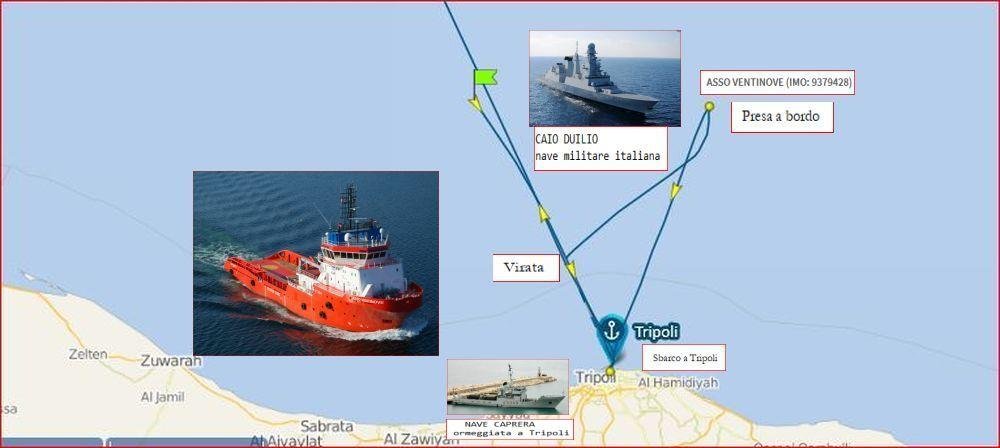
Cronology
1 July 2018
04:03 UTC: sunrise in Tripoli.
Early morning: three inflatable boats fleeing Libya are in the Mediterranean Sea. Two are still in the Libyan SAR (Search and Rescue) zone, while the location of the third is uncertain. In any case, all three are in international waters [1]. We call them the First, Second and Third inflatable boat according to their position:
- the first is the closest to Libya
- the third is the furthest away
- the second is in serious trouble and the refugees call for help using a Thuraya satellite phone. It would be important to have access to these calls, but we do not have it yet[2].
Around 07:20 UTC: a EUNAVFOR MED (the then Sophia European mission) reconnaissance aircraft, during its daily flight to identify boats escaping from Libya, spots the first inflatable boat about 30 miles from the Libyan coast.
Source: the report of the destroyer Caio Duilio, which does not indicate the aircraft name or the coordinates.
Analysis by JLProject: it is unusual for a report drafted by the Navy to omit these details.
EUNAVFOR MED itself admitted usually sending information on sightings to the Italian, Maltese and Libyan Maritime Rescue Coordination Centres. We do not know if this is what happened in this specific case, but the information by EUNAVFOR MED certainly reached Operation Mare Sicuro of the Italian Navy, i.e. the Caprera ship. The OMS informs its military vessels, including the destroyer Caio Duilio C554, which, according to the Italian Navy itself, is very far from the inflatable boat, 171 miles away.
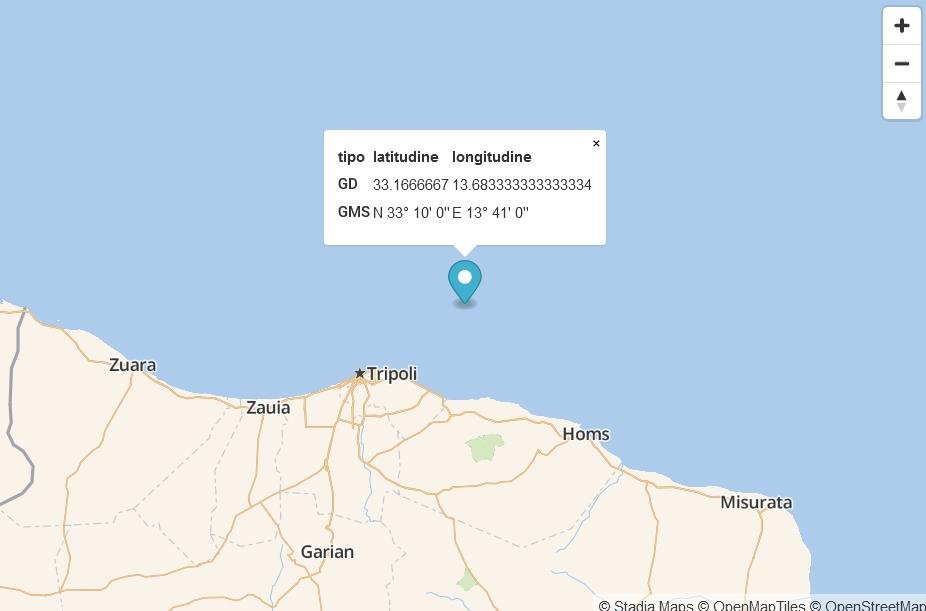
07:28 UTC: the Rome MRCC (Maritime Rescue Coordination Centre) sends a first INMARSAT (International Maritime Satellite Organization) message. This is relayed at 09:31 UTC. The MRCC requests assistance for a vessel with around 100 people on board sighted at 07:28 UTC with coordinates 33.10N 013.41E.
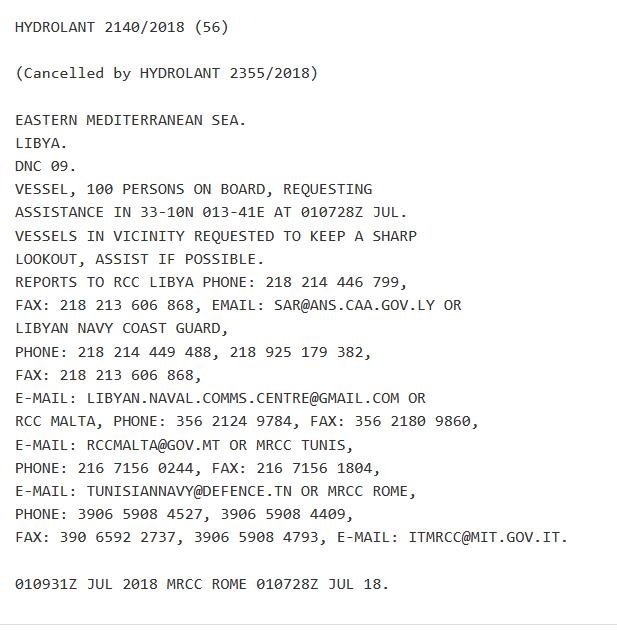
This is the position (compatible with the three inflatable boats of the Asso Ventinove case).
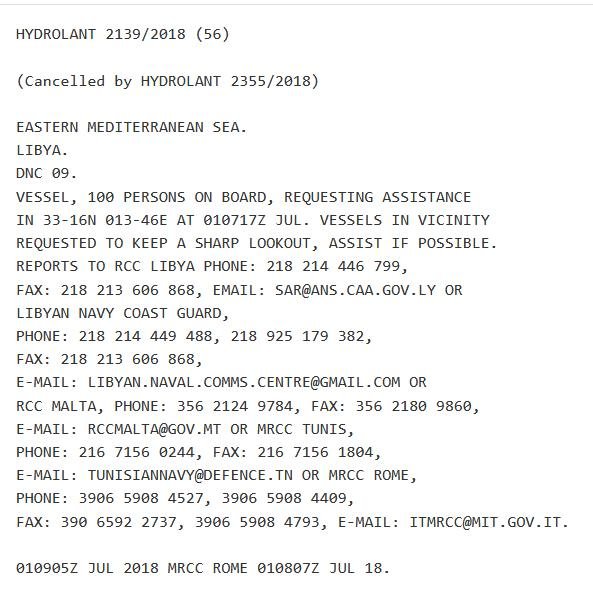
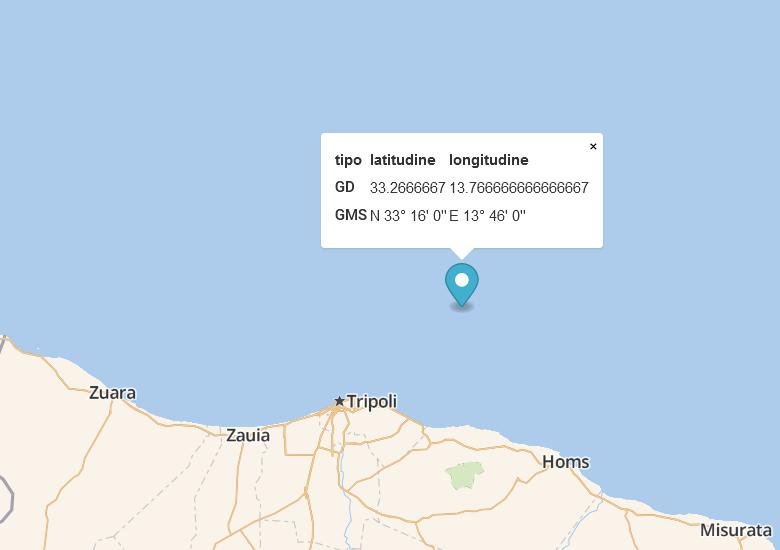
08:07 UTC: the Rome MRCC sends a second INMARSAT message for a second vessel in distress. This will be relayed by the system at 09:05 UTC. It requests assistance for a vessel with around 100 people on board sighted at 07:17 UTC with coordinates 33.16N 013.46E.
This is the position (compatible with the three inflatable boats of the Asso Ventinove case).
08:30 UTC: the Libyan patrol boat Zuwara 644, which is in contact with the Italian authorities, departs from the port of Khoms directed toward the vessel which has been spotted. The OMS immediately informs the Carlo Duilio with a communication at 08:31 [3].
09:30 UTC: the EUNAVFOR MED reconnaissance plane spots a second inflatable boat. It is not indicated in what conditions this is (i.e. afloat or capsized). The information is relayed to the OMS.
09:56 UTC (11:56 local time): the Caio Duilio writes in its report that the EUNAVFOR MED reconnaissance plane has informed the OMS that the second inflatable boat has capsized and that there are people in the water. From survivor testimonies we know that almost all drown. Of more than 100 people who were on the inflatable boat, including women and children, only 18 will survive.
10:16 UTC: the OMS orders the naval vessel Caio Duilio to proceed at maximum speed to reach the two inflatable boats and to launch the helicopter EliDuilio, a rescue helicopter equipped with self-inflating life boats[4].
For one hour (according to the Italian Navy) or three hours (according to the survivors), Karim, Harry and other refugees who have survived the inflatable boat sinking, try to stay afloat. Many do not make it. Karim’s brother drowns. They see the helicopter of the Carlo Duilio circling above them, giving them some hope. But the helicopter does not drop self-inflating life boats or any other life‑saving equipment.
10:45 UTC (12:45 local time): the patrol boat Zuwara arrives and rescues the 18 survivors. Many of them are injured. The rescue operation lasts around one and a half hours.
Indara, the socalled coastguard of the patrol boat Zuwara 644 , takes some photos and will publish them a few days later on his personal Facebook page.
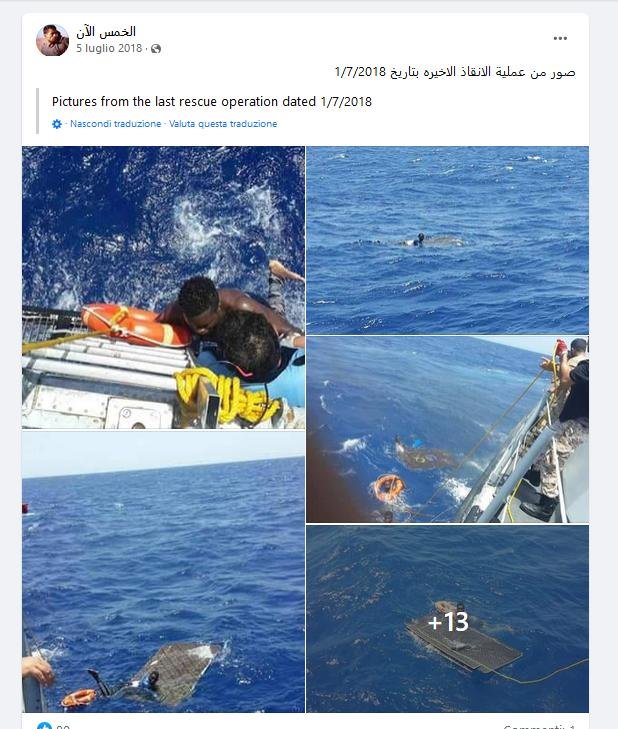
Rgownas, the spokesperson of the Libyan militia, will also post photos and a report of the pushback (at the following links https://x.com/rgowans/status/1014204845581045765 and https://x.com/rgowans/status/1014718360725147648 but he will omit that Italian ships were present. Moreover, he will incorrectly report 41 survivors instead of 18, as revealed by photos and testimonies.
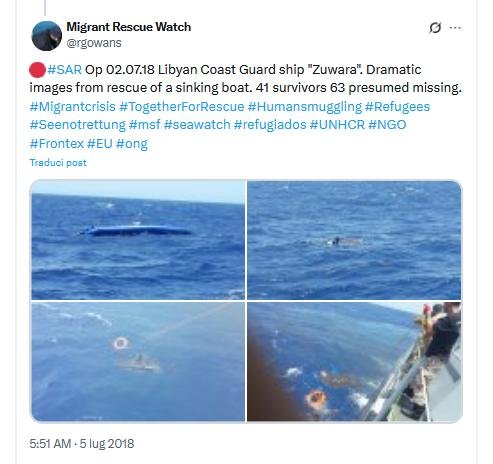
The bodies of the approximately 100 people who drowned (including many women and children) are not recovered.
12:30 UTC: the first inflatable boat sails north without any problems. The sea is rough, but the engine is working and the boat proceeds. Suddenly a helicopter appears in the sky: it’s the EliDuilio, which is flying back to the Carlo Duilio for refuelling. The helicopter circles for some time over the inflatable boat and then flies away. Twenty minutes later, the patrol boat Zuwara 644 intercepts and boards the inflatable boat and takes all the people on board captive.
13:30 UTC (15:30 local time): on the third inflatable boat, with the Eritreans Ato, Chris and Kissa, two things happen. The good thing is that the people fleeing Libya are convinced they have crossed over the ‘death border’ of the Libyan SAR into the Maltese SAR[5]. The bad thing is that the engine has stopped. Waves are higher and higher so they telephone for help. The call, according to their testimonies, is made to the Italian rescue services[6].
14:00 UTC (16:00 local time): the Italian helicopter of the Carlo Duilio appears in the sky and like a big fly buzzes over the inflatable boat for around three hours[7].
16:00 UTC (18:00 local time): the huge Italian naval vessel, the Carlo Duilio, is a few miles away from the third inflatable boat. But it does not intervene.
16:45 UTC (18:45 local time): the patrol boat Zuwara reaches the third inflatable boat and boards.
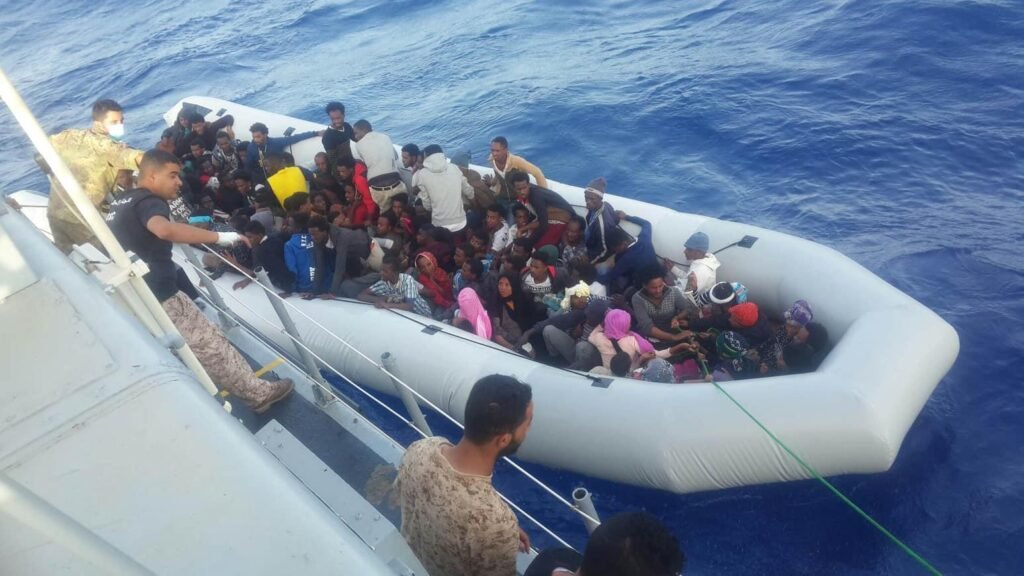
Source: Rgowans, the spokesperson of the Libyan militia at this link https://x.com/rgowans/status/1016049668621467650/photo/1
The Zuwara militia forcibly take all the asylum seekers and pack them together with those already on board. In total there are 276 people, too many for a small patrol boat like the Zuwara.
17:45 UTC (19:45 local time): the Zuwara finishes transferring the deportees and prepares to return to Libya. With too many people on board and rough seas, the cramped patrol boat moves slowly south. Waves crash onto the deck; Dahia, who is eight months pregnant, and other girls begin to vomit. Seawater flows everywhere and the so-called Libyan coastguards realize that the bilge pumps are not working as they should. After only twenty minutes the situation is already critical. The Zuwara asks the gigantic Caio Duilio for help. The ship could take the refugees on board, but it does not and remains inert a short distance away.
18:18 UTC: sunset in Tripoli.
19:00 UTC (21:00 local time): the situation on board the Zuwara is really critical. The patrol boat has taken on a lot of water, the pumps are still malfunctioning, and the vessel risks capsizing and sinking. On the Duilio they discuss the possibility of sending spare parts but, once again, not of bringing the passengers to safety.
20:10 UTC (22:10 local time): the Italian private vessel Asso Ventinove, sailing from Tripoli to the Bouri Field platform, receives a call from the Italian Navy based in Tripoli[8], ], with instructions to proceed immediately towards a Libyan coastguard vessel in distress. The coordinates are provided for the Zuwara, which despite the problems, continues sailing south. They are 33°37′ N 013°50′ E. The communication is recorded in the logbook of the Asso Ventinove[9].
20:15 UTC (22:15 local time): the Asso Ventinove ship changes course and heads east, as shown in the navigation logs.
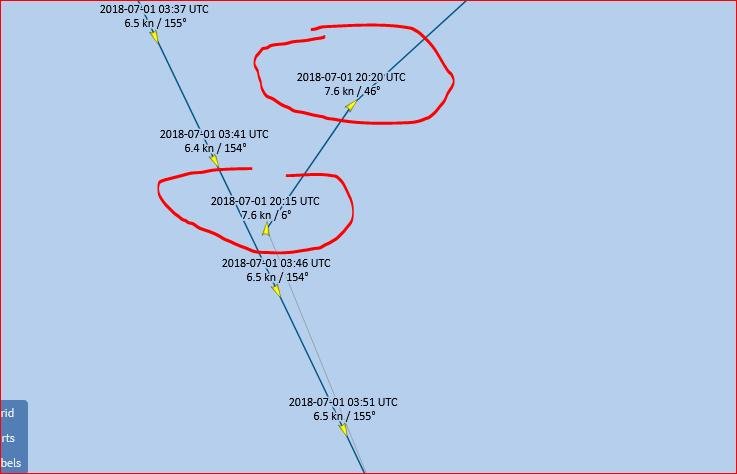
Between 20:15 and 23:21 UTC, the Asso Ventinove heads straight to the Zuwara, at a maximum speed of 9.8 knots. During this time, it receives at least four updates from the Italian Navy on the coordinates of the Zuwara, which continuously changes its position because it goes on sailing south.
Meanwhile the sea rises to force 4 and the wind to 30 knots. On the Zuwara the situation is extremely dangerous.
Around 21:00 UTC, the patrol boat Ras el Jadir 648, one of those donated by Italy to Libya[10]], departs from Tripoli. At roughly the same time the EliDuilio helicopter is withdrawn and sent towards the coast so as not to put the pilot into danger. The Caio Duilio, 152 meters long, remains the entire time a short distance from the Zuwara without intervening.
23:30 UTC: the Ras el Jadir 648 arrives on the scene but cannot provide assistance. It is too small to take the people on board and it has no mechanics capable of repairing the Zuwara.
23:12 UTC (01:12 local time): the OMS informs the Asso Ventinove of the presence, on site, of the missile cruiser Caio Duilio. Shortly afterward, upon arriving on the scene, the Asso Ventinove sights the Caio Duilio, stationary offshore. From this moment on, the Italian naval personnel on the Duilio also give instructions to the Asso Ventinove.
23:30 UTC (01:30 local time): the Asso Ventinove comes alongside the Zuwara, which is now at the coordinates 33°32′ N 013°31′ E.
0:12 UTC (2:12 local time): transfer of those rescued from the Zuwara to the Asso Ventinove begins: 262 (according to the Asso Ventinove) or 276 (according to the Libyans). Among them, according to the Libyans, there are 54 minors and 29 women. At least one of them is pregnant (personally known to JLProject).
Between 00:20 and 00:58 UTC and between 00:58 and 01:21 UTC, the transponder of the Asso Ventinove is switched off or stops functioning, with gaps of 28 and 23 minutes, respectively. It is therefore not possible for us, now, to visualize the transfer operations on the navigation logs. According to the testimonies of the survivors, it is the women, among them Dahia, eight months pregnant, who speak with the Italian crew as soon as they board the ship. They say they are Eritrean and want to request asylum in Italy. The crew tells them: “We will take you to Italy, now sleep.”
1:20 UTC (3:20 local time): the transfer is complete and the ship sets off again.
JLProject analysis: legally, the shipwreck survivors, in international waters, boarded a vessel flying the Italian flag. According to the international law of the sea, from 01:20 UTC on 2 July 2018 they were on ITALIAN TERRITORY, subject to the laws of the Italian State. These laws provide for the right to asylum and prohibit collective pushbacks of foreigners at the borders and individual pushbacks of unaccompanied minors.
Night, after 1:20 UTC: the tracking data, from this time onward, show the Asso Ventinove heading straight towards Tripoli at a constant speed of 5.5 knots. The patrol boat Zuwara, now empty, is being towed by the Italian ship. On board the Asso Ventinove, the shipwreck survivors are convinced they are sailing north, towards Italy. Some of them are actually sleeping.
04:04 UTC: sunrise in TripoliIn the morning, instead of Italy, the port of Tripoli appears. The refugees realize this when still on the ship. The women recount asking the crew for an explanation and receiving this response: “Last night we contacted the Italian authorities and they told us to take you to Libya. Italy does not want you.” On hearing the news, Cris hides on the Asso Ventinove, with the idea of remaining on board and coming out some time later[11].
8:37 UTC (10.37 local time): the Asso Ventinove enters the port of Tripoli and stops about 200 metres from the Italian naval vessel Caprera. The shipwreck survivors are disembarked using the Libyan patrol boat 648, the Ras Al Jadir, which had followed the Italian vessel all night during its return to Libya. On board the Asso Ventinove they count the deportees and realize that Cris is missing. They search the entire ship and find him under a tarpaulin.
The disembarkation takes place on the Abu Sitta quay, right in sight of the Caprera (its identification number A5349 is clearly visible) and right under the eyes of the UNHCR staff, who send a photographer (Sufian Arara, also known as Sufian Said) to take pictures and someone else with a smartphone to take additional ones. We therefore have a photograph of the moment:
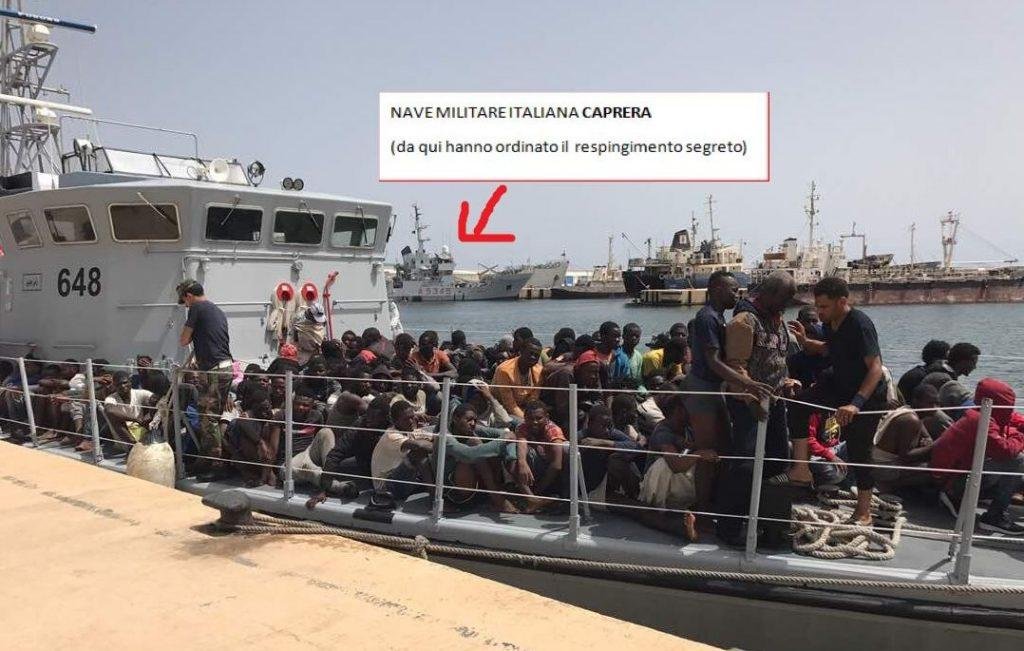
09:41 UTC (11:41 local time): the Asso Ventinove leaves, abandoning the asylum seekers to their fate.
For the rest of the morning of 2 July 2018, the staff of UNHCR and IOM assist the shipwreck survivors and, according to their testimonies, record their names and other data on paper. We have tweets with photos documenting these moments.
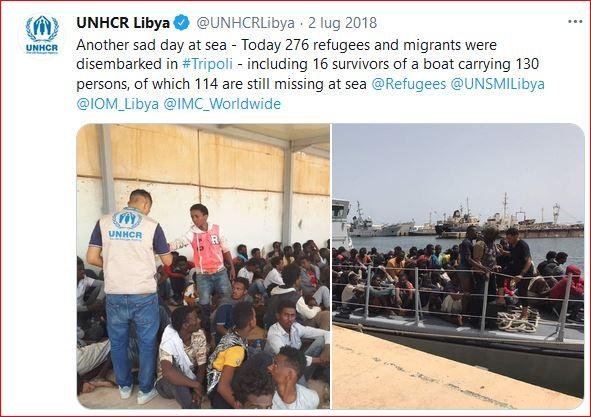
Link https://x.com/UNHCRLibya/status/1013839026535661568 e https://x.com/IOM_Libya/status/1013803854243221504
The staff of IOM and UNHCR clearly see the Asso Ventinove carrying out an illegal pushback, but they say nothing about it.
Afternoon of 2 July 2018: the shipwreck survivors are locked up in the Libyan detention camps of Tarek al Mattar and Triq al Sikka.
In the following months: at the end of July, a baby boy, Loni, is born to Dahia at the terrible detention camp of Trik al Sikka. In September, those who had ended up in Tarek al-Mattar are transferred to Zintan. Josi dies there after a few months, from hunger and illness, without any help or medical assistance, on the floor of the camp in Zintan. Seid and six other asylum seekers[12] will also die after the deportation.
Neither the Italian Navy, the Italian Ministry of Foreign Affairs, UNHCR, nor IOM will publicly reveal that this secret illegal pushback happened.
Discovery of the Asso Ventinove case and the birth of the JLProject
In Spring 2019, while investigating the twin Asso Ventotto case, Sarita discovered this huge illegal, secret pushback carried out by the private Itaian vessel Asso Ventinove on orders of the Italian Navy. She founded the Josi & Loni Project (JLProject), from the names of Josi, who died on the floor of the Libyan camp in Zintan, and Loni, who was born on the floor of the Libyan camp in Triq al-Sikka.
Today the JLProject has around 50 activists and conducts forensic investigations to bring to court hundreds of illegal pushbacks from the sea to Libya (www.jlproject.org). The people who survived the Asso Ventinove pushback have filed lawsuits against the Italian government and so far they have won all of them. To explore the various aspects of this case in more detail, a lot of material can be found here: https://saritalibre.it/caso-asso-ventinove/
Won and ongoing legal cases
Thanks to collaboration with the ASGI Sciabaca & Oruka project, all the people who were pushed back and later traced by JLProject have received legal assistance.
The legal cases won so far are:
• Compensation claim for those pushed back in the Asso Ventinove case. The court of first instance ordered the Italian government and the Asso Ventinove to pay compensation to the claimants of €15,000 each. The ruling was appealed by the State Attorney’s Office and the appeal proceedings are currently underway.
• The Italian government was ordered to admit to Italy the refugee Harry Abdulatif, who had been illegally pushed back to Libya. Abdulatif arrived from Tripoli to Rome on a commercial flight and we went to pick him up at the airport. Today he lives in Rome and works as a human rights activist.
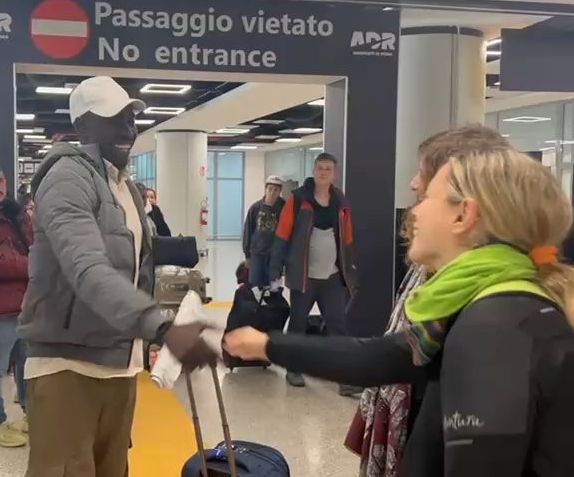
Many other people pushed back have filed lawsuits against the Italian government and are waiting for the judgments.
The people who were pushed back and later identified by JLProject now almost all live in Europe or America, but eight of them are still in Libya, exposed to the criminal system of forced labour and detention camps financed and supported by the Italian government. We are waiting for a decision of the Italian court to free them.
Little Loni now lives in Europe with his mother, his father, and two younger sisters. He is a happy child and reminds us, the JLProject activists, that achieving justice is possible.
Note
[1] International waters are located outside 12 nautical miles from the coasts of individual states. They are spaces in which international laws apply. The SAR zone, on the other hand, is simply an area in which a particular state has assumed the duty of carrying out search and rescue operations for people shipwrecked at sea, and this does not imply any national sovereignty over the area concerned.
[2] After the refusal of the Ministries headed by Toninelli and De Micheli, the lawyers of those who were pushed back filed a third request for access to official documents.
[3] The port of Khoms is not the closest to the inflatable boat that needed to be rescued. It is 45-50 miles away, while Tripoli is only 30 miles away. The nearest naval vessels are therefore the Caprera and any patrol boats anchored in Tripoli, but they are not used.
[4] These are rather strange orders for an Italian Navy that today claims it did not take part in the SAR event. In any case, a question remains: why involve the Caio Duilio if it was really so far from the inflatable boats? The ship’s maximum speed is 31 knots; to travel 170 miles it would need five and a half hours! Why, instead, did OMS not send its own naval vessel Caprera, which was in the port of Tripoli only 30 miles away, or at least the Ras el Jadir patrol boat?
[5] Their GPS indicated this and they were convinced of it.
[6] But this is a detail we cannot confirm, because the call was made via Thuraya by a refugee whom we have not been able to locate again and because – as you know – the Italian government has not given us copies of the recordings. The only certain fact is that the Italians learned about it IMMEDIATELY and sent the helicopter from the Caio Duilio to the location.
[7] Remember that a SAR operation, by law, can only be opened after direct visual contact; a phone call requesting help is not sufficient. In the case of the third inflatable boat, the first direct visual contact was precisely the sighting by the Italian military helicopter EliDuilio, which remained above the boat for three hours, participating very actively in a SAR event for which no one had yet taken responsibility. I recall that the Caio Duilio was engaged in Operation Mare Sicuro (OMS), an operation that manages and has the authority to manage SAR events.
[8] That is, from the Caprera.
[9] This step will be discussed extensively in court, but in our view the facts could not be clearer: the Italian Navy ordered the Asso Ventinove to head towards specific coordinates to intervene in a SAR operation. EDIT: all the judges who have issued rulings in the Asso Ventinove case have since agreed with us.
[10] It is impossible to know why it did not set sail hours earlier, when there was still time to save Karim’s brother and all the women and children who drowned.
[11] Note from Sarita: Knowing Cris, and especially knowing the horror he wanted to avoid, it does not seem like such an absurd plan. I often imagine a group of sailors convinced that their ship is haunted by a polite ghost who steals food from the galley but disposes of the waste properly and washes the dishes he uses. The sailors fear him and believe he is there to confront them with all their sins. They pray to God, cry, and repent. The next morning they arrive in Valletta, Malta. And the ghost leaves them free.
[12] Over the years JLProject has worked hard to keep the memory of the people who died because of this illegal deportation ordered by the Italian government and carried out by the Asso Ventinove commanded by Corrado Pagani.
Josi, Amela, and Seid are in our hearts and fill us with the strength that is constantly necessary to uncover, piece by piece, case after case, the genocidal system of captures at sea and deportations to Libyan camps that the Italian government has criminally created.