


The database project
The Database of Illegal Pushbacks in the Central Mediterranean is a documentation project that aims to make public the vast amount of data collected over the years by activists who, in various capacities, offer support to migrants who are victims of serious fundamental rights violations.
Beyond their intrinsic documentary value, these data form the basis for the work of reconstructing the facts that the Josi and Loni Project (JLProject) has been carrying out since 2019. Over the years, over 600 victims have been traced and interviewed.
Thanks to the work of the lawyers at Sciabaca & Oruka (ASGI), for some cases of illegal pushbacks, which were properly reconstructed and documented, it was possible to initiate civil proceedings, obtaining several convictions and the effective recognition of migrants’ rights.
However, to stem this phenomenon, it is not enough to simply take some of those directly responsible to court. These injustices and acts of violence are the direct consequence of Italian and European migration policies, which have become geared toward building a repressive legal and administrative apparatus, systematically denying the fundamental rights of vulnerable groups such as asylum seekers through the outsourcing of border controls. Numerous independent organizations have been denouncing for years how these policies, and the resulting international agreements, fuel human trafficking by providing traffickers with political legitimacy as well as significant economic resources.
The Database of Illegal Pushbacks in the Central Mediterranean is a large, free, and open-access online calendar that will collect documentation of approximately 1000 cases of illegal pushbacks. These pushbacks have led to the deportation of tens of thousands of migrants to Libyan detention centers, exposing them to serious violations of fundamental human rights.
Successes already achieved
We’re always pleased to highlight legal actions won thanks to the evidence obtained by JLProject. These victories in particular:
- Compensation lawsuit for those rejected in the Asso Ventinove case
- The Italian government ordered to admit refugee Harry Abdulatif to Italy, illegally returned to Libya
- The Italian government ordered to admit refugee Adam to Italy, illegally returned to Libya
The investigation work
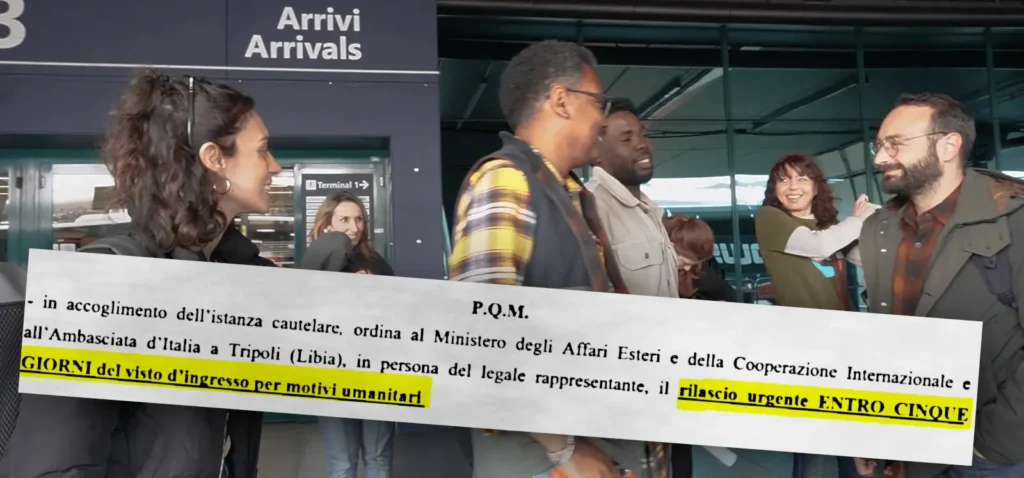
To prove these violations, it is necessary to find evidence of the illegality of the pushbacks, trace the people rejected, and chronologically reconstruct the events through photographic material, direct testimonies of the victims, flight traces, and other public data collected online, as well as requests for access to institutional records. All this material is incorporated into a case dossier.
An example of case reconstruction.
The project’s goals
The project’s primary objective is to legally assist people illegally returned by sea to Libya and Tunisia.
The project’s overall objective is to contribute to the analysis of Italian and European migration policies from a human rights perspective, to facilitate understanding of their outcomes and impacts, and to address the factors that lead to serious and systematic violations of fundamental rights.
What we do is:
- facilitate the judicial investigation of serious human rights violations of refugees, asylum seekers, and foreign nationals fleeing their countries of origin or transit and attempting to reach European shores, and help ensure their effective access to international protection;
2. document and record, as detailed as possible, the systematic violations of international human rights law along migration routes to Europe.
Another expected outcome is a significant increase in the legal support that can be offered to victims of collective refoulements to assert their rights in the appropriate forums. This will therefore expand collaborations with other law firms and beyond.
Who works there?
The Database of Illegal Pushbacks in the Central Mediterranean is an internal project of JLProject on which activists from the JLProject collective work.
Furthermore, several groups of students and researchers collaborate on the project:
- A student group from Sciences Po University in Menton (FR)
- The Tuesday working group at Spin Time
- A group from the Legal Clinic of Roma Tre University
- A student group from Goldsmiths University in London (UK)
Our supporters
The project is funded thanks to the contributions of countless people, ordinary citizens who read us, share our investigations, cheer us on, and support us.
Our supporters also include:
The idea for Mediterranea was born in the summer of 2018, sparked by outrage over the thousands of deaths in the Mediterranean and the policy of closed ports. From a group of individuals and associations, the civil society platform organized itself and quickly launched the first, and still only, Italian-flagged civilian rescue ship. Exactly five years after the tragic Lampedusa massacre, the Mare Jonio set sail from the port of Augusta on its first monitoring and rescue mission on the night of October 3-4, 2018.
Donate something – even a little – just to let us know you're there and rooting for us.