


| status | Legal Proceedings |
| name | 20180821_A_lib |
| date | 2018-08-21 |
| number_of_people | 138 |
| victims_found | some |
| patrol_boat | Ras el Jadir 648 |
| disembark_place | Tripoli |
| prison | Tarek al Matar |
| related_icao | |
| link | https://twitter.com/rgowans/status/1032307335446884352 |
Funded by your donations, this investigation was a success. Donate something to help investigate other rejections!
20180821_A_lib – Ras Jadir 648
21 August 2018
Il 2On 20 August, at 23:00 UTC, a dinghy with 138 people, among which were 14 women and 13 children, set sail from Al Zawiya.
After approximately 17 hours of navigation, the dinghy broke down; distress calls were made from the vessel. The migrants sighted ships in the vicinity that never provided assistance.
At 16:00 UTC the dinghy was intercepted by the Libyan patrol boat Ras Jadir 648.
At 22:00 UTC disembarking took place in the Tripoli naval base; subsequently the migrants were transferred to the Tarek al Matar prison.
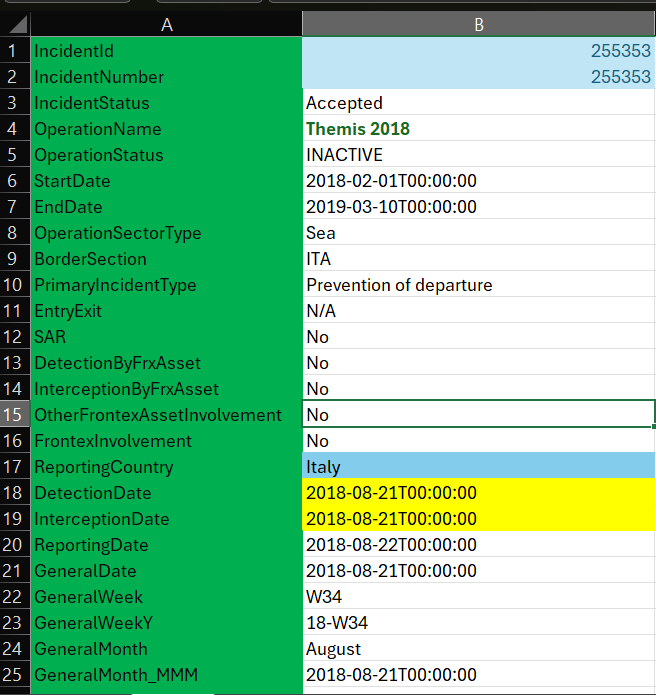
This case is a Themis case no. 255353 and involves the Italian state (reporting country: Italy).
Distress call made in Italian: after approximately 17 hours of sailing, the dinghy began experiencing problems. The refugees dialled one of the numbers written on a piece of paper that they had received shortly before leaving the port; they made a distress call that was answered by someone speaking Italian.
- JLp hypothesises that the migrants called the Italian Coast Guard, as the dinghy was heading towards Lampedusa: the call took place entirely in Italian;
- JLp hypothesises Italy’s involvement either through the Maritime Rescue Coordination Centre (MRCC) in Rome (call in Italian) and/or through coordination from Tripoli. In fact, at that time, the ship Gorgona was present in the Libyan capital, deployed for the MARE SICURO mission;
Six pushback victims, one of whom is identifiable (S.), the others are recognisable but we are unable to clearly identify them.
Operation Themis:case no. 255353/255353
Analyzing the Frontex report, the case was registered on 22 August 2018, with ID: 255353, by an operator based in Italy (reporting country: Italy);
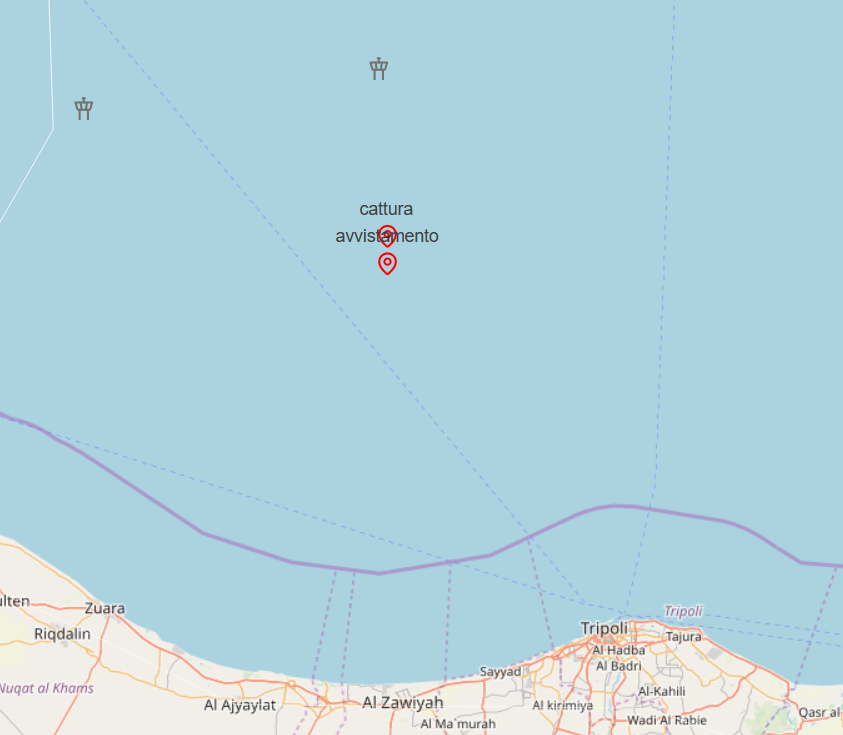
Frontex provides coordinates:
latitude of interception: 33.616666666666700 longitude of interception: 12.700000000000000 latitude of sighting: 33.566666666666700 longitude of sighting: 12.700000000000000 |
The coordinates of the sighting and the interception are almost identical; this is justified by the breakdown of the dinghy.
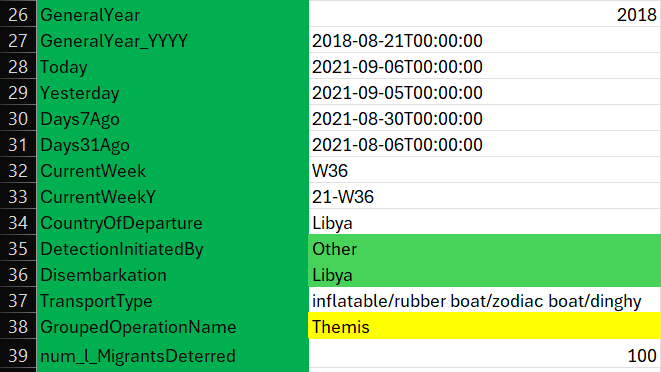
Among the Themis operations, an interception is described which, in our opinion, appears to correspond to the interception of S.’s dinghy: dinghy disembarked in Libya, approx. 100 pax.
Themis Report
Sighting and interception coordinates indicated in the Themis report:
Timeline
20 August 2018
SUNSET at 18:04 UTC (20:04 CEST)
at 21:00 UTC (23:00 CEST), the migrants about to cross are put on a bus and taken to the port of Al Zawiya. [source: pushback victims]
at 23:00 UTC (01:00 CEST) the dinghy with 138 people on board departs towards Lampedusa; this destination is entered into the GPS. [source: pushback victims]
the dinghy carries 138 people, including 14 women and 13 children.
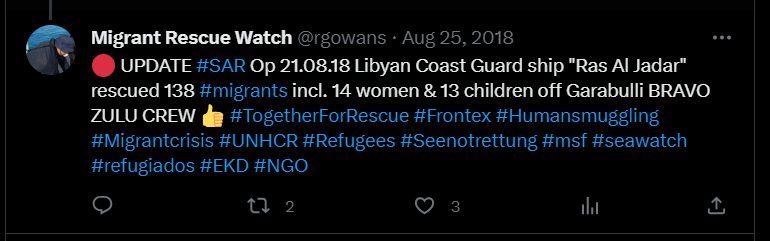
https://twitter.com/rgowans/status/1032307335446884352
The nationalities of the 138 people are diverse: Mauritania, Chad, Egypt, Sudan, Nigeria, Mali, Senegal, Gambia and the Ivory Coast (many women were from the Ivory Coast).
21 August 2018
SUNRISE at 04:24 UTC (06:24 CEST)
Around 14:00 UTC (16:00 CEST) A. speaks with fishermen aboard a light-blue fishing boat; who point the migrants in the right direction for Lampedusa. The fishermen do not speak Arabic; they speak a language that A. does not recognise. [source: pushback victims]
14:00 UTC:
https://x.com/ItaMilRadar/status/1031908970401853440 ItaMilRadar publishes the tweet at 14:20 UTC (16:20 CEST)
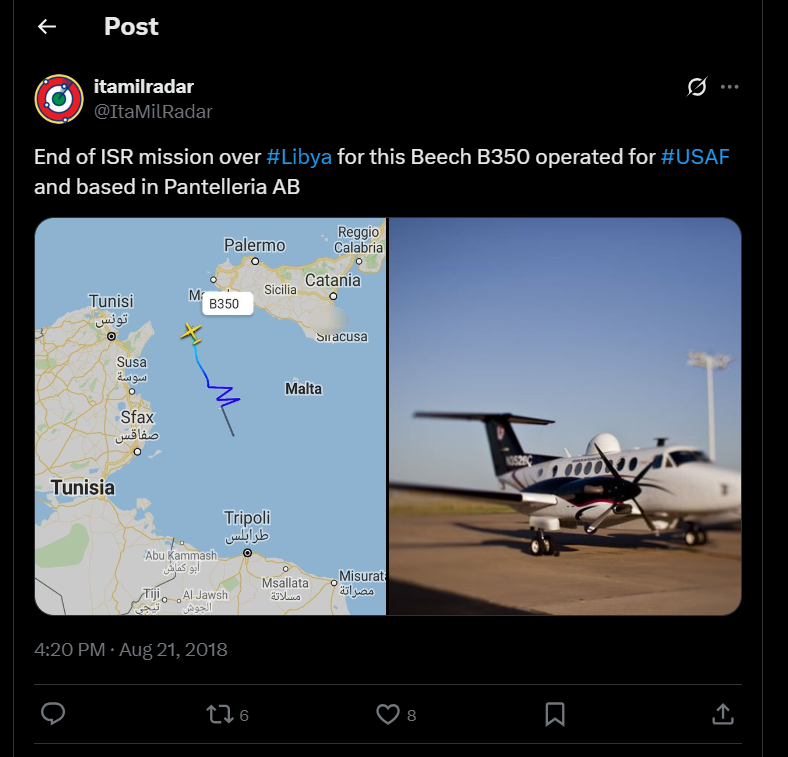
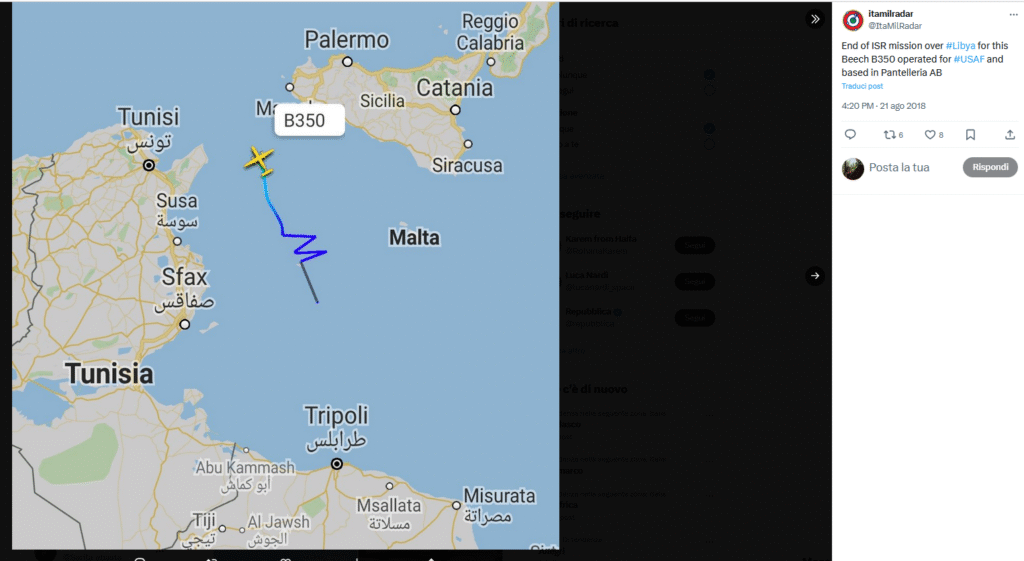
Around 15:00 UTC (17:00 CEST) a white and red aircraft (red with white details) flies over S.’s dinghy, performs three reconnaissance laps and then leaves the area. [source: pushback victims]
Everyone on board the dinghy tries to attract the attention of the aircraft flying overhead.
Shortly after 15:30 UTC (17:30 CEST) the dinghy is taking on water; and the pushback victims see two ships in the distance: a red and black merchant ship with a white superstructure (K. recalls different colours, remembering the ship as white and red) and a military ship flying the Italian flag. [source: pushback victims]
The two ships are not far from the dinghy. They remain stationary and do not prepare to rescue the dinghy in distress, despite the migrants’ cries for help. [source: pushback victims]
A distress call is made from the dinghy using a satellite phone. [source: pushback victims]
A person speaking Italian answers, so the satellite phone is handed to one of the women on board who speaks Italian very well (the woman was likely of Nigerian nationality).
Shortly after 16:00 UTC (18:00 CEST), on 21 August, the day of Eid, the Libyan patrol boat Ras Jadir stops the dinghy and forces the migrants to board in order to take them back to Libya. (Source: testimony of pushback victims)
SUNSET at 18:02 UTC (20:02 CEST)
after 22:00 UTC, around midnight local time, the Libyan patrol boat docks at the port of Tripoli. Many of the refugees are registered by the Libyan police and photographed. [the pushback victims recall being assisted and receiving water, but they cannot remember whether IOM or UNHCR or MSF were present at disembarking.]
Around 00:00 UTC (02:00 CEST), after dividing the group of 138 people into two subgroups (men and women), the Libyan authorities, present at the port, transfer the refugees to the Tarek al Matar prison.
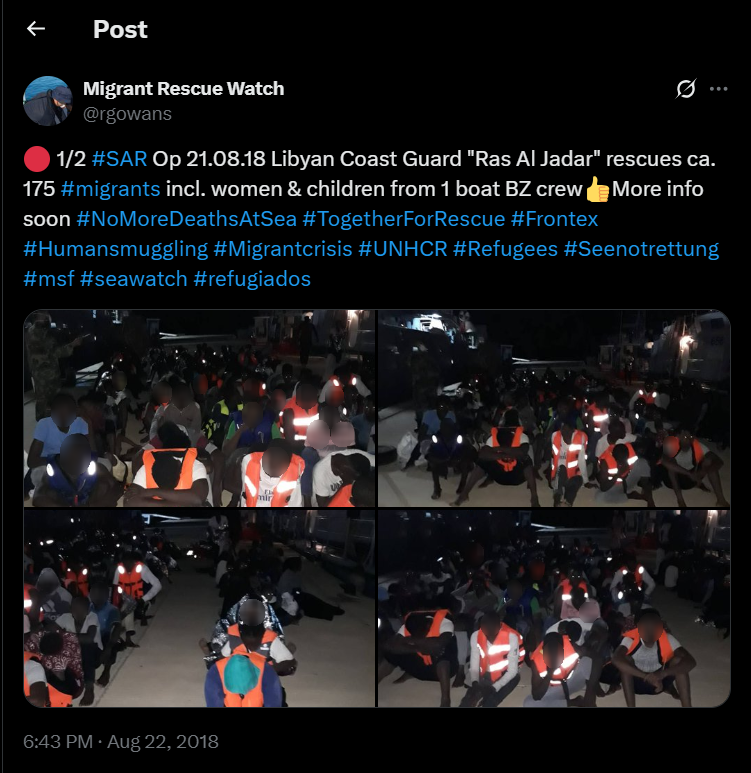
@rgowans posts images and a video of the moment of disembarkation on their X account; as can be seen from the images, the disembarkation certainly took place many hours after dusk.
Link: https://twitter.com/rgowans/status/1032307335446884352
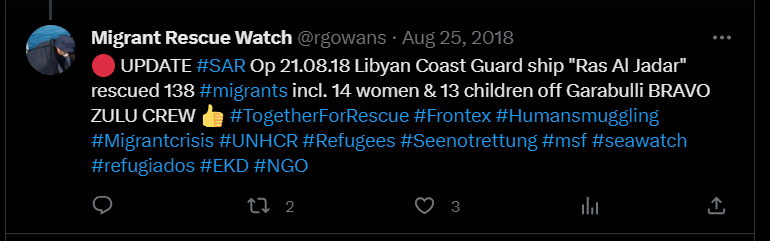
The images show migrants at the naval port of Tripoli; it is night.
——————————————————
Considerations:
Considering the evidence collected and the reconstruction of the case, we can infer that the pushback victims called an Italian number, most likely the Italian Coast Guard; Alarm Phone (AP), usually contacted by migrants in distress, answers in English; moreover, we know that the dinghy was moving towards Lampedusa: this could confirm our hypothesis.
We strongly believe that the so-called Libyan Coast Guard intervened because it was informed of the presence of the migrants’ dinghy, most likely coordinated from Tripoli through officers on board the ship Gorgona, a military ship deployed to train and support the Libyan Coast Guard (Mare Sicuro mission).
Evidence of Italian state involvement:
Taking into consideration the reconstruction provided by the pushback victims with whom we are in contact, we hypothesised the presence of Italian military vessels; therefore, we reconstructed the movements of Italian military ships that in 2018 were sent to Tripoli under OPERATION MARE SICURO, within the framework of the Bilateral Assistance and Support Mission (MIASIT):
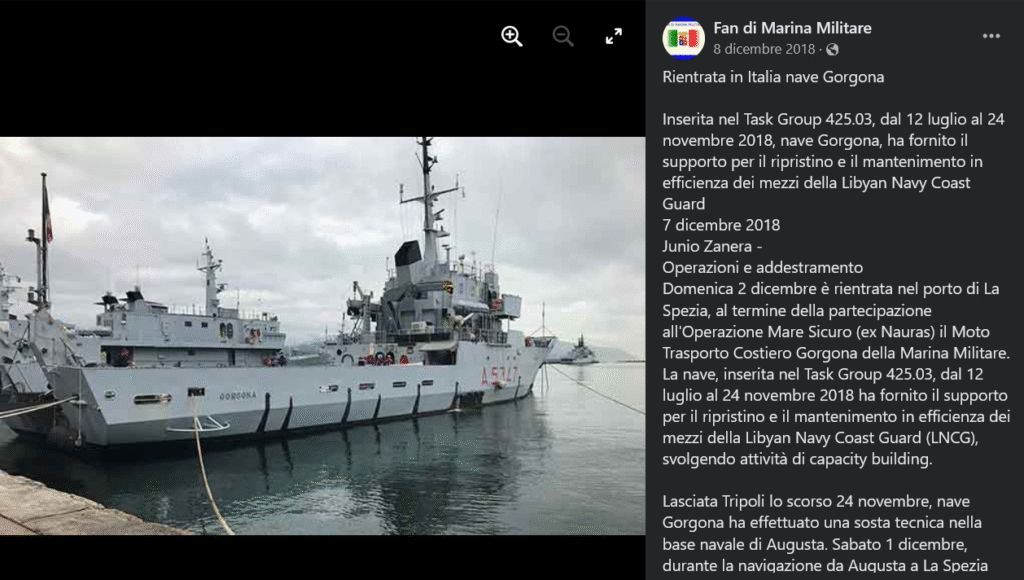
Source: https://www.difesaonline.it/news-forze-armate/mare/rientrata-italia-nave-gorgona:
…On Sunday 2 December, the Coastal Transport Vessel Gorgona of the Italian Navy returned to the port of La Spezia, at the end of its participation in Operation Mare Sicuro (formerly Nauras). The ship, part of Task Group 425.03, from 12 July to 24 November 2018 provided support for the restoration and maintenance of efficiency of the assets of the Libyan Navy Coast Guard (LNCG), carrying out capacity-building activities.
After leaving Tripoli on 24 November, Nave (ship) Gorgona made a technical stop at the naval base of Augusta. On Saturday 1 December, during navigation from Augusta to La Spezia in the waters off Livorno, the Commander-in-Chief of the Naval Squadron, Squadron Admiral Donato Marzano, from aboard Nave Duilio, went on board the ship to greet the crew upon their return, after 135 days in the operational theatre.
At 10:00 on Sunday morning, once moorings were secured, the crew of Nave Gorgona was able to reunite with their loved ones, thus effectively concluding the mission…
https://www.facebook.com/FAN.DI.MARINA.MILITARE/photos/a.198153596866814/2512885308726953/?type=3:
https://www.rid.it/shownews/2277/tripoli-nave-caprera-rileva-nave-capri:
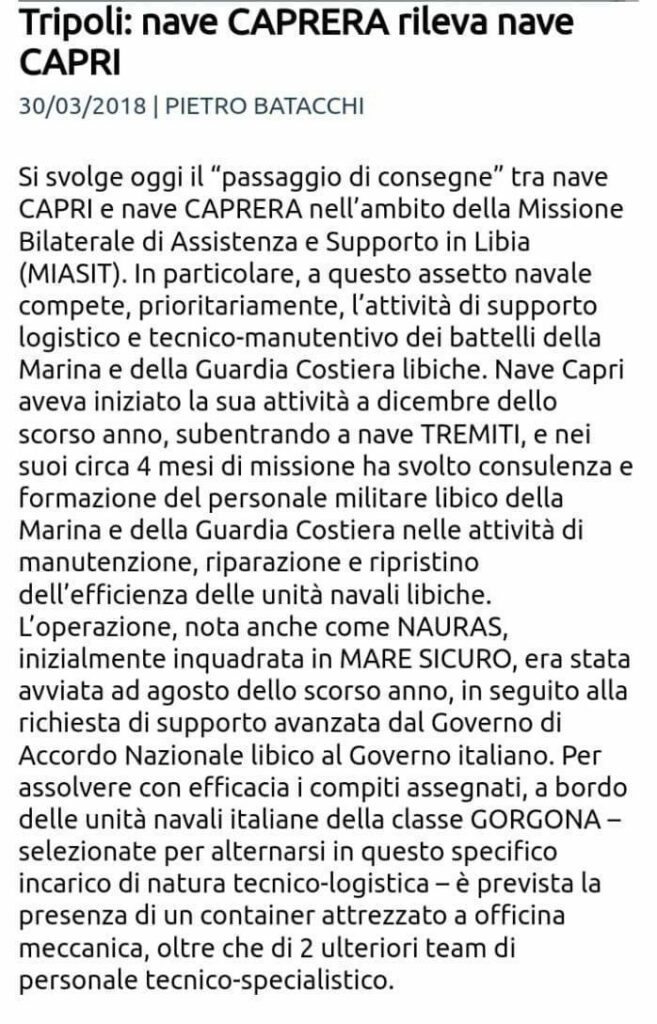
The ship Gorgona replaced the ship Caprera in Operation mare sicuro; the aim of this operation was to “coordinate, educate, train and save” migrants; this is reported by Salvini, then Minister of the Interior and Deputy Prime Minister of the Conte I government, on his YouTube page: https://www.youtube.com/watch?v=Spx2n7L7meo&t=51s
Furthermore, in this video Salvini adds … “honour to the boys of Caprera who … block departures, reduce the number of deaths” …
“From 1 January 2018, the tasks of the mission were expanded and now include activities of support and assistance to the Libyan Coast Guard and Navy, strengthening what was already being carried out by the Italian Navy operating in the Mediterranean.”
Since the ship Gorgona replaced the ship Caprera in Tripoli, we can hypothesise that it managed and coordinated the maritime operations of the so-called Libyan Coast Guard, since that was precisely the purpose of the mare sicuro military operation.
We recall once again that the emergency call made by the migrants before the arrival of the Libyans, conducted entirely in Italian, leads us to believe that the Italian state is involved in this pushback. The involvement is also confirmed by the Themis report [reporting country: Italy].
We also know that in the Mediterranean Sea, within the Mare Sicuro mission, other ships were involved besides Gorgona: Nave Rizzo, flag ship, Nave Alpino, Nave Carabiniere, Nave Bettica (http://www.marina.difesa.it/media-cultura/press-room/comunicati/Pagine/2018_126.aspx ), therefore, we can believe that one of these may be the Italian military ship sighted by the six victims with whom we are in contact.
Other useful materials:
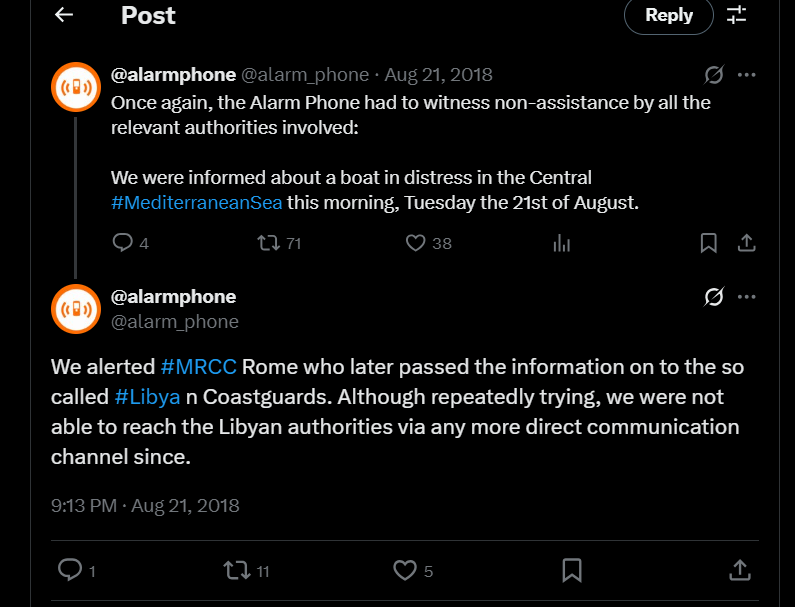
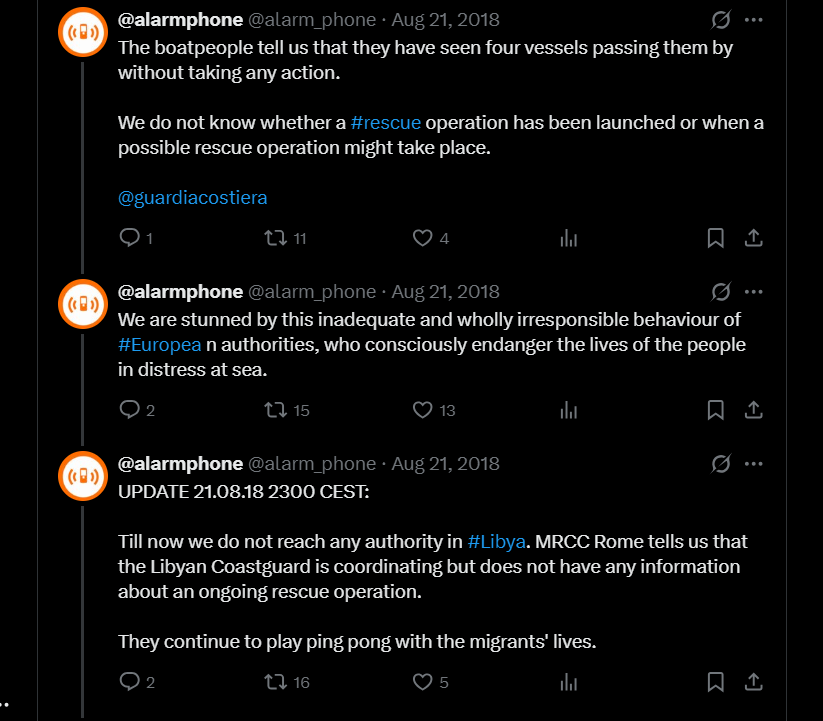
Alarm Phone reports the presence of a vessel in the central Mediterranean. In various tweets it states that it was contacted by a vessel carrying migrants and that it therefore alerted the MRCC Roma, which in turn passed the information to the so-called Libyan Coast Guard.
The migrants sighted four ships that remained inactive.
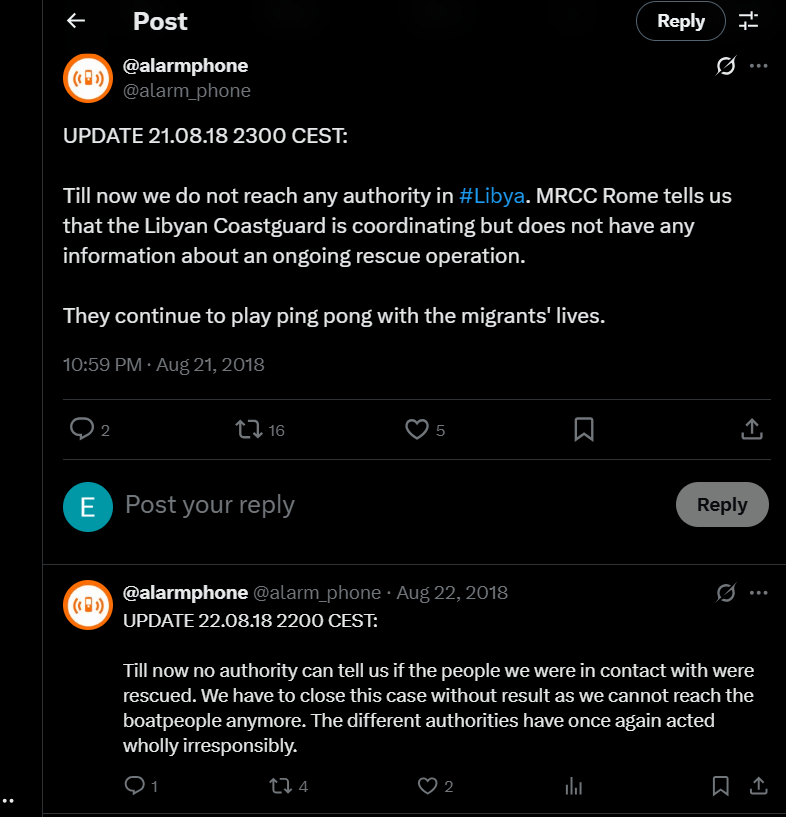
AP was never able to get in touch with the Libyan authorities.
The MRCC Roma informed AP that the Libyans were coordinating the recovery of the migrants.
AP once again denounces the failure to provide assistance by European authorities.

The English version of this dossier was translated by IN.TRA (Inclusive Translation for Community Engagement), a pro-bono language services provider as part of a service-learning project within the Department of Interpreting and Translation (DIT) at the University of Bologna.